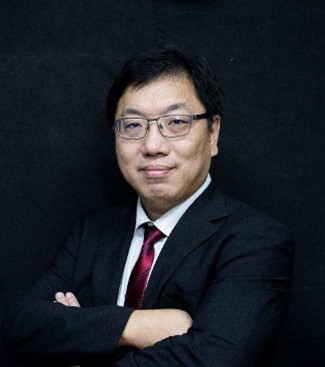
|
Prof. Chen-Hao Wang, Ph.D.
Chairman and Professor, Department of Materials Science and Engineering
Associate Dean, College of Engineering
National Taiwan University of Science and Technology
Joint Appointment Researcher, Research Center for Critical Issues, Academia Sinica
|
Speech Title: Precise Atomic-Level Engineering of Electrocatalysts Unlocking the Potential of Next-Generation Fuel Cells and Electrolyzers |
Professor Chen-Hao Wang is the Chairman and Professor of the Department of Materials Science and Engineering, and the Associate Dean of the College of Engineering at the National Taiwan University of Science and Technology (NTUST), as well as a Joint Appointment Researcher at Academia Sinica.
Professor Wang’s work is noted for developing innovative non-precious metal catalysts for fuel cells and enhancing electrode performance in all-vanadium redox flow batteries. In this capacity, he leads a key academic-industry alliance to advance the applications of all-vanadium redox flow battery technology. In parallel, he develops advanced catalysts for various fuel cells, including both proton-exchange and anion-exchange membrane types.
A prolific scholar, Professor Wang has authored over 112 SCI papers (h-index: 37), holds 15 patents, and is ranked in the top 1.06% globally in the energy field by ScholarGPS. Beyond his research, Professor Wang actively collaborates with industry and holds key leadership roles in several academic organizations, including serving as the Vice President of the Taiwan Association for Hydrogen Energy and Fuel Cell, and as a director in the Taiwan Energy Society and the Electrochemical Society of Taiwan, demonstrating his significant impact on both academia and industry.
|
|
Prof. Chung-Jen Tseng
Distinguished Professor, Dept. Mechanical Engineering
Director, Center for Energy Research
College of Engineering, National Central University, Taiwan
|
Speech Title: GQD-modified CoFe-LDH@nickel foam as a high-performance anode catalyst for anion exchange membrane water electrolysis |
Dr. Chung-Jen Tseng is presently a distinguished professor and the director of the Center for Energy Research at College of Engineering, National Central University, Taiwan. He received his Ph.D. degree in Mechanical Engineering from The University of Texas at Austin, USA. Professor Tseng also serves as a National Climate Change Committee member, an Executive Director of Taiwan Association for Hydrogen Energy and Fuel Cells, a Section Editor of the Journal of Energy Engineering. He received the 2024 Outstanding Research Award from the National Science and Technology Council of Taiwan. His current research interest is in energy conversion and storage, such as fuel cell (PEM & SOFC) material development, innovative fuel cell and stack design, hybrid system analysis and design, and hydrogen production by water electrolysis. |
|
Professor Dr. Jesús Toribio
ESIS Fellow (ESIS: European Structural Integrity Society)
ICF-WASI Director (ICF-WASI: International Congress of Fracture-The World Academy of Structural Integrity)
Chairman of the ESIS Technical Committee 10 (TC10) on Environmentally Assisted Cracking (EAC) &Hydrogen Embrittlement (HE)
Head of Fracture & Structural Integrity Research Group (FSIRG).
University of Salamanca (USAL),E.P.S., Campus Viriato,SPAIN
|
Speech Title: Hydrogen Transport by Diffusion in the Vicinity of Cracks and Implications in Hydrogen Embrittlement of Structural Materials
A Tribute to Antonio Machado and Thomas Stearns Eliot |
Professor Jesús Toribio graduated in Civil Engineering in 1982 and then in Mathematics in 1986. In 1987 he was awarded his PhD in the Polytechnic University of Madrid (UPM) and turned into Associate Professor in that Institution. In 1992 he became Full Professor and Head of the Materials Science Department of the University of La Coruña (at the age of 32, thus being the youngest Full Professor in the area of Materials Science in Spain). In 2000 he moved to the University of Salamanca (USAL) where is currently Full Professor of Materials Science & Engineering and Head of the Fracture & Structural Integrity Research Group (FSIRG) of that Institution.
His research work is mainly concerned with fatigue and fracture mechanics, environmentally assisted cracking, stress corrosion cracking and hydrogen embrittlement/degradation/damage of metals and alloys (mainly cold drawn pearlitic steel wires for civil engineering and austenitic stainless steels for nuclear engineering and energy applications), covering theoretical, computational and experimental aspects. He actively participates in International Scientific Conferences, very often being a member of the International Advisory Committee, organising Special Sessions and Symposia, being Session Chairman or specially delivering Plenary/Keynote/Invited Lectures. Professor Dr. Jesús Toribio has published more than 600 scientific papers, most of them in international books and journals.
He is the Chairman of the Technical Committee 10 (TC10): Environmentally Assisted Cracking & Hydrogen Embrittlement of the European Structural Integrity Society (ESIS) and has been Director (2013-2017) of the International Congress of Fracture-The World Academy of Structural Integrity (ICF-WASI), being responsible of launching the Ibero-American Academy of Structural Integrity (IA2SI). Prof. Toribio has been awarded a variety of scientific research prizes and awards including: (i) UPM Young Scientist Award of the Polytechnic University of Madrid; (ii) METROTEC Award for the best Technological Research Project; (iii) Honour Medal of the Spanish Group of Fracture (GEF/SEIE) in recognition of his research achievements in the field of fracture mechanics; (iv) Fellow of the Wessex Institute of Technology (WIT) in recognition of leadership and outstanding work in engineering sciences; (v) Top Reviewer 2011 in recognition of an outstanding contribution to the quality of the Elsevier International Journal Engineering Fracture Mechanics; (vi) Fellow of the European Structural Society (ESIS Fellow) for his outstanding contributions to the art, science, teaching or practice of fracture mechanics and his service to the society; (vii) Honorary Member of the Italian Group of Fracture (IGF) in acknowledgement and appreciation of his outstanding achievements in the research field
of fracture mechanics; (viii) Best Paper and Presentation Award in the International Conference on Energy Materials and Applications (ICEMA 2017) held in 2017 in Hiroshima, Japan, with a paper entitled: Numerical Simulation of Hydrogen Diffusion in the Pressure Vessel Wall of a WWER-440 Reactor; (ix) María de Maeztu Scientific Award of the University of Salamanca (800th anniversary during 2018) in recognition of academic trajectory and excellence in scientific and technological research; (x) Scientific Merit Award of the Portuguese Group of Fracture (PGF) in recognition of scientific contributions during his career.
|
Apply to become a keynote speaker
Deliver an English speech relates to the conference theme. Get free conference documents. Get a Speaker Certificate after the conference finishes. If your research area covers the conference themes, and you would like to join us, please send your information to emai committee@heet-18.org.
How do I apply?
To apply, simply send your personal CV, title and abstract of your speech to committee@heet-18.org
When will I be informed whether I am successful?
Both successful and unsuccessful applicants will be notified via email after we confirmed whether your research area is consistent with the conference topic or not.